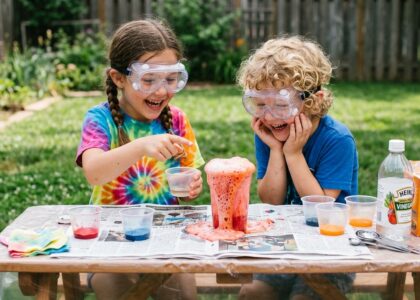
Discover the Magic of Homemade Sugar and Vinegar Fireworks Transform your ordinary kitchen into a vibrant laboratory of color, movement, and discovery with this mesmerizing sugar and vinegar fireworks experiment. This fun activity combines simple household ingredients with scientific curiosity to create stunning bursts of color that resemble tiny fireworks dancing in a liquid. This experiment will captivate both children and adults, turning chemistry into a fun spectacle and providing a visually stunning learning experience.
Using just a few readily available ingredients, we can create a display of vibrant, overlapping colors, bubbling reactions, and shimmering chemical action that brings science to life. The beauty of this experiment lies in its simplicity and its ability to illustrate chemical reactions in a captivating way.
Understanding the Science Behind Sugar and Vinegar Fireworks
The vibrant movement we see in this experiment comes from a fascinating interplay between density, chemical reactions, and diffusion. When vinegar reacts with baking soda, carbon dioxide gas is rapidly produced, creating a bubble-like motion that propels the colored liquid upwards in dynamic streams. The sugar contributes to increasing the liquid’s density, allowing the colors to move and spread in captivating visual patterns.
As these reactions occur, we see:
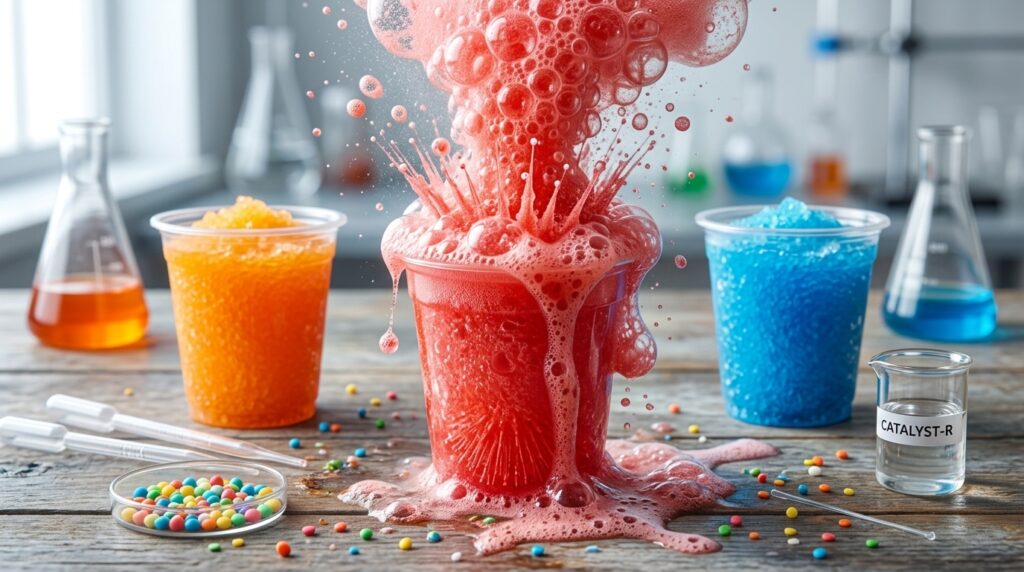
• Colorful explosions resembling miniature fireworks
• Rapid bubbles resulting from the formation of carbon dioxide
• Overlapping liquids that create swirling visual effects
The result is a small but dazzling chemical display that combines art and science.
Ingredients for a Sugar and Vinegar Fireworks Experiment
We gather simple materials commonly found in most kitchens. These ingredients are inexpensive and safe when used correctly.
Ingredients for a Sugar and Vinegar Fireworks Experiment
We gather simple materials commonly found in most kitchens. These ingredients are inexpensive and safe when used correctly.
Basic Ingredients
• 3 tablespoons white sugar
• 1/2 cup white vinegar
• 1 tablespoon baking soda
• 1 cup warm water
• Food coloring (preferably several colors)
• 2 tablespoons cooking oil
Tools and Supplies
• Clear glass bowl or jar
• Small mixing bowls
• Stirring spoon
• Droppers or teaspoons for adding color
Using a clear bowl allows you to see each swirl and burst of color clearly, enhancing the visual excitement of the experiment.
How to Make Sugar and Vinegar Fireworks Step by Step
Step 1: Prepare the Sugar Solution
Begin by dissolving three tablespoons of sugar in a cup of warm water. Stir well until the sugar is completely dissolved. The sugar thickens the liquid, helping the colors to move slowly and dramatically.
After mixing, pour this solution into the clear glass bowl.
Step 2: Add a Layer of Oil
Next, gently pour two tablespoons of cooking oil into the glass bowl. The oil floats on top of the sugar solution because of its lower density, creating an ideal environment for colorful, firework-like reactions.
The oil layer also allows the food coloring droplets to collect before being released.
Step 3: Prepare the Vinegar Mixture
In a small bowl, mix half a cup of vinegar with a few drops of food coloring. Use different colors if possible; red, blue, green, and yellow make a stunning display.
Each color will travel through the oil layer as separate droplets.
Step 4: Create the Firework Effect
Using a spoon or dropper, slowly add small drops of the colored vinegar mixture to the oil layer.
At first, the droplets settle on the surface of the oil, then gradually sink through to the sugar solution.
As the colored droplets are released, they begin to spread in beautiful streams, resembling tiny underwater fireworks.
Step 5: Start the Chemical Reaction
Now add the final ingredient. Sprinkle a tablespoon of baking soda into the cup.
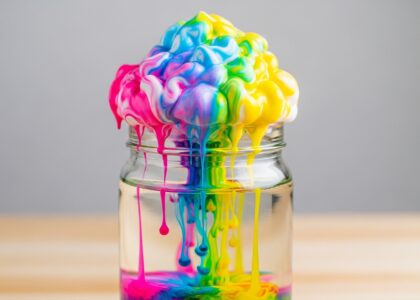
As the colored droplets are released, they begin to spread in beautiful streams, resembling tiny underwater fireworks. Vinegar reacts instantly with baking soda, producing carbon dioxide bubbles. These bubbles propel the colored liquid upwards, creating flashes resembling slow-motion fireworks.
The vibrant colors blend together, rising and falling as the bubbles continue to rise.
Why does sugar enhance the fireworks effect?
Sugar plays a crucial role in this experiment. When dissolved in water, it forms a denser solution beneath the oil layer. This density difference causes the color droplets to move slowly and dramatically once they reach the bottom layer.
The denser solution allows the colors to diffuse outwards like bursting fireworks, producing elegant patterns reminiscent of color explosions in the night sky.
Without sugar, the colors would diffuse too quickly, and the visual effect would be less dramatic.
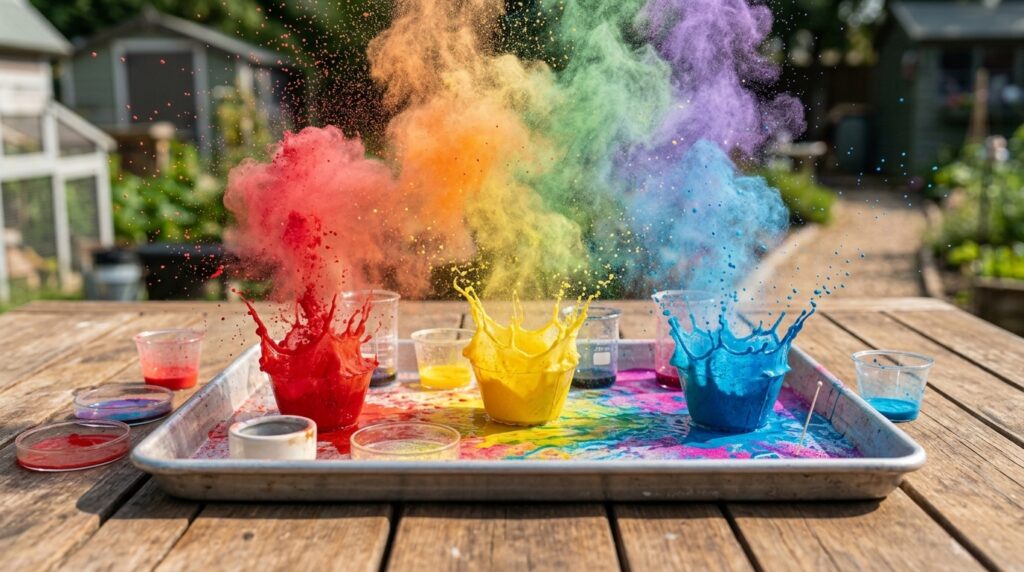
Create a stunning multi-colored fireworks display
To make the experiment even more exciting, you can prepare several different colored vinegar mixtures. Adding each one separately creates a spectacular cascade of colors that blends seamlessly within the liquid.
Create a stunning multi-colored fireworks display
To make the experience even more exciting, we can prepare several vinegar mixtures in different colors. Adding each one separately produces a dazzling cascade of colors that blend within the liquid. For a more dramatic effect, we recommend using:
• Dark red • Electric blue • Bright yellow